New M.Zuiko 12-50mm f/3.5-6.3 lens announced

Olympus today announced a new Micro Four Thirds zoom lens, the M.Zuiko Digital 12-50mm f/3.5-6.3. The lens covers a range of 24-100mm in 35mm full-frame terms, which is 2mm (4mm-eq.) wider and 8mm (16mm-eq.) longer than the current kit lens offering, the M.Zuiko Digital 14-42mm f/3.5-5.6. On the downside, the initial aperture at the long end is only f/6.3, which is only usable in good light or with a flash.
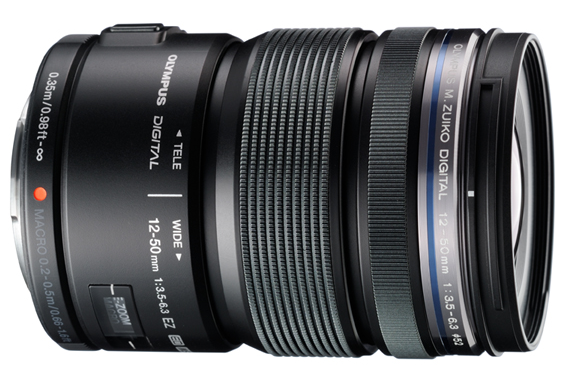
M.Zuiko Digital 12-50mm f/3.5-5.6

The lens adds the powerzoom feature already known from Panasonic’s new X lens series, which means the zoom is operated via a rocker instead of via twisting the zoom ring. As a bonus, the lens has macro capabilities with a minimum focusing distance of 20 cm / 0.66 ft. It is also completely weather sealed — something which many Micro Four Thirds users have been waiting for, although this would make most sense on an equally weather seales body, which is not available as of yet.

The estimated retail price of the new lens is US-$ 499, with shipping commencing early 2012. The lens will be available in black and silver colours.

Read more at dpreview.com.

My photographic christmas wishlist

These days I’ve been thinking a lot about stuff I’d like to treat myself with for christmas. Alas, the budget for new toys roughly equals zero this year. Still, being the gearhead that I am, here’s a list of what I would have Santa bring me :-)

  • M.Zuiko Digital 45mm f/1.8 — Olympus’ latest Micro Four Thirds lens offering, equivalent to a 90mm portrait lens / short tele in 35mm terms. Being raved about by everyone who has it, and generally getting quite favourable reviews. This would complement my Lumix 20/1.7 nicely for a two-lens kit.
  • Voigtländer Nokton 40mm f/1.4 — The fastest 40mm lens for 35mm photography, and conviniently this comes in M-mount. Since its über-fast sibling, the Nokton 35/1.2, is not only two to three times as expensive, but also two to three times as large and heavy, this would make for a nice carry-anywhere 50mm-equivalent available-light lens on my M8.
  • Leica CL 35mm rangefinder camera — the camera that almost killed the M series. Much smaller and lighter than its M siblings, the CL was manufactured by Minolta and features 40, 50 and 90mm framelines. It’s one of the smallest M-mount cameras, has an integrated light meter and would nicely lend itself at being used with the 40mm Nokton. Also, it’s beautiful!
  • Leica M Thumbie — a less expensive and less obtrusive alternative to the Thumbs Up grip by Match Technical. The Thumbie is attached to the back of your Leica M by adhesive tape, and thus keeps the hot shoe free for accessories. It’s also smaller than the Thumbs Up and only half the price.
  • Leather half case for the Leica M8 — there are many varieties of this very useful and very good-looking accessory. I would want one in light brown (“cognac”) with an integrated grip, preferrably the Mr. Zhou version. Protects the camera, makes it look nice and provides grip.

What would you like Santa to bring you for christmas?

Panasonic announce GF1-successor GX1

Finally! After years of waiting, Panasonic today announced a true successor to their popular GF1 compact Micro Four Thirds camera. After introducing the “dumbed down” GF2 and GF3 cameras, many users felt that Panasonic was on the wrong way, focusing too much on the entry level consumer market than at the advanced/enthusiast market. The GX1 now follows in the steps of the GF1, featuring full manual controls again, as well as a solid body that will appeal to all who seek an advanced but compact interchangeable lens camera.

The new Panasonic GX1 obviously follows the steps of the GF1.

Technically, the GX1 isn’t much more than a slightly advanced GF1, featuring roughly the same design philosophy. But even if it is just a mere “up to date” version, it brings enthusiasts exactly what they were waiting for — the idea of the GF1 with the technology of today.

The Panasonic GX1 features the latest 16 megapixel Micro Four Thirds sensor that is also being used the G3, Full HD video recording, and can make use of a new 1.44 million dot electronic viewfinder which, however, is not backwards compatible to the GF1.

For more information you can find a quick hands-on preview of the GX1 over at dpreview.com. Also, make sure to check out 43rumors, who will undoubtedly soon cover all the various announcements, previews, hands-ons as well as possibly full reviews of the GX1.

EDIT: The guys over at dpreview.com have made some fancy side-by-side comparisons between the GX1 and the GF1, showing nicely how much the GX1 is really an iteration of the GF1 philosophy.

In-stock alert: X100, X10 and Zuiko 45/1.8 at B&H

B&H currently has a limited amount of three hot photographic items in stock, namely the

which needs no introduction as I am sure most of you know what it is capable of and what its specs are.
Next up is the brand new

the Fuji X100′s little sister, sporting a 28-112mm f/2-2.8 Fujinon zoom lens, a large 2/3″ EXR CMOS sensor and a state-of-the-art optical viewfinder that is a lot more sophisticated than those you find on comparable high-end compact cameras like the Canon G series or Nikon P series.
The third hot item currently in stock at B&H is the new

the first dedicated portrait lens for the Micro Four Thirds system, and this lens is already a legend. Creamy smooth bokeh, tack sharp from f/1.8 on, lightweight and at a price that is a no-brainer.

If you want to acquire any of these, I suggest you act quick as these will sell out like hotcakes!

Building the perfect BUDGET Micro Four Thirds kit

Steve Huff recently published an article titled “Building the perfect Micro 4/3 Camera kit for under $2500“, in which he talks about his favourite Micro Four Thirds cameras and lenses and where to get them. While his “perfect kit”, consisting of an Olympus E-P3, Zuiko 12/2, Panasonic Lumix 20/1.7, Zuiko 45/1.8 and the VF-2 viewfinder, is certainly a killer combo, it also comes with a killer price tag – US-$ 2,697.85 if you buy from B&H Photo.

Not all of us have that much money to spend, so here’s my suggestion for the perfect BUDGET Micro Four Thirds kit.

Camera: Olympus E-PL1

The Olympus E-PL1 was the third Micro Four Thirds camera to be released by Olympus. While it has less buttons for direct feature access than the E-P1/2, it inherits the E-P2′s viewfinder connector and adds a “Live Guide” that helps you with choosing settings. It has also got a weaker AA filter than the E-P1/2 which provides slightly crisper images. All in all, the E-PL1, while more than a generation old now, is still capable of producing excellent results and can currently be had for as little as US-$ 399.99, including the 14-42mm kit lens, which is a nice allround lens for general shooting.

Alternative 1: If you don’t need the possibility to add an electronic viewfinder, you can get the E-P1 used for even less.

Alternative 2: The successor to the E-PL1, the E-PL2, brings back the sexy retro design of the E-P1/2, has more direct access buttons and features the new Accessory Port 2, to which several new accessories can be installed. It comes at US-$ 499.99 including the kit lens.

Lens: Panasonic Lumix 20mm f/1.7

This was the first serious prime lens for the Micro Four Thirds system in that it was the first with an aperture large enough to make available light photography possible. Its field of view, corresponding to that of a 40mm lens on 35mm (full frame) is one of the most versatile. It is wider than a 50mm, which can sometimes be too narrow, yet not quite as wide as a 35mm, which can be a tad too wide sometimes, yielding unnatural distortion. Photographer Sally Mann describes the 40mm focal length as being “about right” for her kind of work. With its maximum aperture of f/1.7, the 20mm can provide nice subject separation and background blurring, while showing only little vignetting wide open and rendering tack sharp in the image center from the start. At currently US-$ 349.87, this lens is a no-brainer.

Lens: Olmypus M.Zuiko 45/1.8

This is the just-introduced portrait lens for Micro Four Thirds. With a field of view equivalent to that of a 90mm lens on 35mm full frame and its wide f/1.8 initial aperture, the lens is suited at both low light photography as well as portraiture, where an isolated subject with a strongly blurred background is wanted. It also functions as a short tele lens, meaning you can isolate subjects that are close up, or crop details in architectural or landscape scenes. All reviewers have been very positive about this lens so far, ascribing it good performance in terms of sharpness, contrast and colour reproduction. At ~ US-$ 399.99 (it’s not available yet at B&H), this is a no-brainer as well, and together with the little 20mm pancake lens makes for a formidable two lens kit.

Accessory: VF-2 electronic viewfinder

According to some, the VF-2 electronic viewfinder is a must-have. With its 1.44 million dots, it provides a crisp and clear preview image and makes precise manual focusing possible. It is also very useful outdoors in bright lighting conditions, where the built-in screen of the camera can get difficult to read. The VF-2 is available new for US-$ 225.82 in the black version.

Alternative: The VF-3 viewfinder, which has lower resolution (9k pixels) and a lower price tag at US-$ 179.99, but will work almost equally as well.

Summary:

Olympus E-PL1 with kit lens: US-$ 399.99
Panasonic Lumix 20/1.7: US-$ 349.87
Olympus M.Zuiko 45/1.8: US-$ 399.99
Olympus VF-2 EVF: US-$ 225.82

Total: US-$ 1,475.67

So, for about half the money that Steve’s “perfect” MFT kit will set you back, you get a kit that is almost as versatile, delivers almost the same IQ and will be equally as much fun! (And if you decide on the VF-3 viewfinder, you’ll save another US-$ 50, and if you decide to get the older E-P1 without a viewfinder, you can save another US-$ 300 and still have a great kit!)

How’s that for a deal?! :-)