Via photoscala.de. Chinese manufacturer ‘Aputure’ present their new external LCD finder called ‘Gigtube’. The finder sports a 2.5″, 230k pixel, tiltable LCD display as well as a remote trigger. It is intended to facilitate framing under difficult circumstances, for example with subjects that are situated below or above the photographer, or to control the camera from afar without losing sight of the subject. It connects to the camera via cable and can be attached to the flash hot shoe, where it acts as a second display. The Gigtube is compatible to a number of current DSLR models, for example current Canon DSLRs as well as Olympus’ E-series and PEN-series cameras.
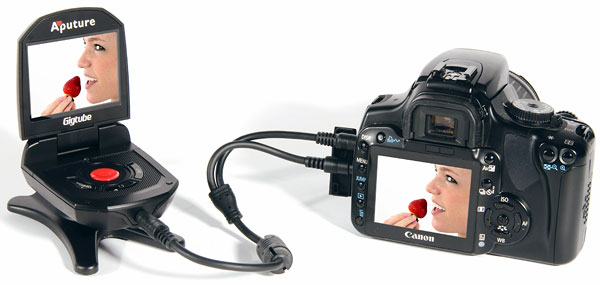 Picture courtesy of photoscala.de. English translation of the photoscala article.
Link to the manufacturer’s website.
A member of the dpreview Micro Four Thrids talk forum made some comparison shots with the Leica branded D Summilux 25/1.4 Four Thirds lens and the Panasonic Lumix G 20/1.7 Micro Four Thirds lens. As was to be expected, the Summilux has substantially less depth-of-field wide open, rendering much more heavily blurred out-of-focus areas. On the other hand, the Lumix is easily as sharp as the ‘Leica’ wide open.
Ah … I love this kind of useless but fun comparison stuff! 😉
And in case you didn’t know, I made a similarly useless comparison once between said Lumix 20/1.7 and the Cosmicar/Pentax 25/1.4 TV lens.
Remember that picture of the concrete mixer behind our house which I posted yesterday? Well, I felt it had to be processed a bit more, so I applied my color/b&w merging process to it – this is the result.
 "The concrete mixer revisited" | Olympus E-P1 + Lumix 20/1.7 @ f/1.7, 1/80 sec, ISO 250 To see how images are affected by this process, you can compare this one to the one I posted yesterday. In essence, by merging a color and a b&w version, the luminance info from the b&w version is applied to the color luminance in the color version, while by choosing a specific merging mode, the microcontrasts are heavily enhanced, giving the image a much more dramatic look.
PhotographyBLOG have just posted their review of Fuji’s F80EXR, successor to the F70EXR, which was Fujifilm’s first compact super-zoom. The main differences between the F80 and the F70 are the new sensor with 12 megapixels, as opposed to the F70’s 10 megapixels, and a slightly larger (but not higher resolving) 3″ display (F70: 2.7″). The F80 now also features 720p HD movie recording, something many Fuji users were missing in previous models. Apart from that (and a few new colors to choose from), the cameras are pretty much the same, sporting a 10x, 27-270mm, F3.3-5.6 zoom lens in a compact, well-built body.
Interestingly, as it appears on the test pictures shown, the F80 seems to hold up a tad better at high ISOs in the EXR SN mode, showing a good balance between noise and detail (even more so than the F70 AND the F200, which were both already quite outstanding performers in their respective classes).
Here’s another one from sunday. Sorry for posting these so quickly in series, but I just had to share this one, too! It’s an out-of-camera JPEG, totally unaltered except for resizing and sharpening. I have to state again that the E-P1’s JPEG engine does exceptionally well at high ISOs in black & white!
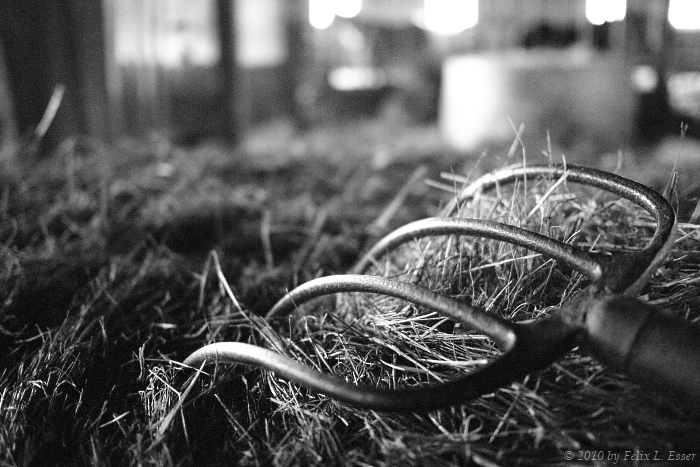 "The hayfork" | Olympus E-P1 + Lumix 20/1.7 @ f/1.7, 1/25 sec, ISO 4000
|
|

 May 5th, 2010, 12:22 pm |
  |
| 


